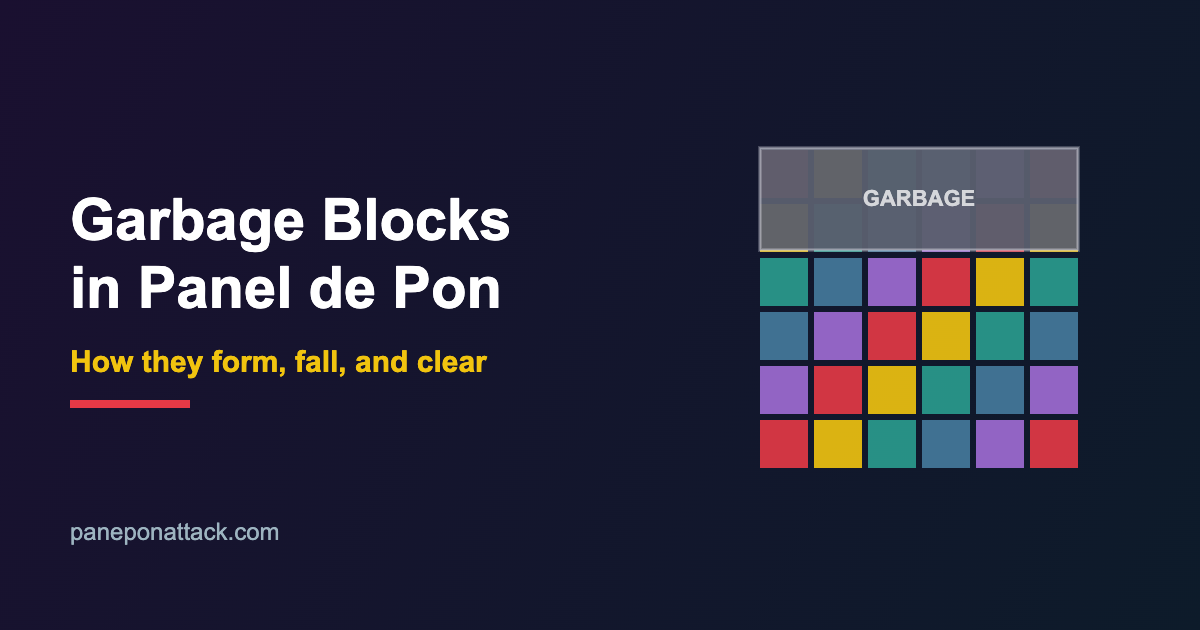
Ask a new Panel de Pon player what garbage blocks are and you will hear some version of “the junk you dump on the other person to make them lose.” That is not wrong, but it hides the point. Garbage is not a damage mechanic. It is a tempo mechanic. Its real value is not the count of blocks you send — it is the seconds of forced work you steal from your opponent, and the tempo swing you get back when your own garbage clears. This guide explains where garbage comes from, how it behaves once it lands, and how to clear it so it works for you instead of against you. It is written for players who can already build a combo or a chain but keep losing the versus race and cannot say why.
What a garbage block actually is
In Panel de Pon (and its Western releases, Tetris Attack and Pokémon Puzzle League), a garbage block is a solid slab that drops onto your opponent’s stack from the top. Unlike normal panels, you cannot swap it, and it does not clear when panels around it match. It just sits there, occupying rows, pushing the opponent closer to the top-out line and forcing them to spend inputs dealing with it instead of building their own offense.
Every garbage block your opponent receives was created by something you did on your board. There are exactly two sources — combos and chains — and they produce garbage of very different shapes, which matters more than most players realize.
The two sources: combos versus chains
A combo is clearing four or more panels in a single match. Combos generate flat, wide garbage: roughly one row tall, and as wide as the combo is large, up to the full six-column width. A combo of four sends a four-wide slab; a six-panel combo sends a full-width bar.
A chain is a sequence of matches triggered by one setup, where clearing panels drops others into new matches. Chains generate tall, full-width garbage: a block six columns wide whose height grows with the chain length. A longer chain does not send wider garbage — it sends taller garbage, stacking rows onto a single full-width slab. If you have worked through how to build a 4-, 5-, and 6-chain, this is where that skill pays off in versus: every extra link is another row of garbage the opponent has to unwind.
Combo garbage vs chain garbage at a glance
| Property | Combo garbage | Chain garbage |
|---|---|---|
| Trigger | Clearing 4+ panels at once | Follow-up matches from one setup |
| Shape | Wide and flat (~1 row tall) | Full six-wide, grows taller per link |
| What scaling adds | More width (up to full row) | More height (more rows) |
| Best used to | Spread pressure across columns | Bury the opponent under a wall |
| Downside for you | Combos are quick but cap at one row | Chains are slow to build and risky if dropped |
The practical takeaway: combos are your fast, low-risk poke, and chains are your slow, high-commitment haymaker. Good players do not pick one — they mix flat combo garbage to keep the opponent busy while they quietly assemble a chain for the tall slab.
How garbage falls and locks
When garbage arrives, it drops from the top of the opponent’s playfield and rests on top of their current stack. While a stack is rising and garbage is stacked on it, the effective ceiling drops fast — this is how a single well-timed chain can end a game that looked even a moment earlier. Garbage that has just landed also briefly delays the panels underneath, because the opponent cannot swap through it and has to route around it.
Timing is everything here. Garbage sent while the opponent is mid-chain lands on an already-tall board and can tip them over. The same garbage sent when their board is low is a minor inconvenience they clear at leisure. This is why “how much garbage” is the wrong question and “when did it land” is the right one.
How you clear garbage
You do not swap garbage away — you transform it. When you make a match with normal panels directly adjacent to a garbage block, the bottom row of that garbage converts into ordinary, colored panels. Those freshly revealed panels can then be matched, and critically, they can be part of a chain. This is the mechanic that separates strong defense from panic: clearing garbage is not just cleanup, it is an offensive opportunity.
The elite move is chaining through garbage. If you trigger a chain next to a garbage slab, each link peels a row off the garbage and feeds those new panels back into the chain, so you clear the incoming wall and fire a tall counter-slab in the same motion. That single exchange is the biggest tempo swing in the game. If the mechanics of setting up those follow-ups are still fuzzy, start with the beginner guide to rules, controls, and your first chain.
Why garbage is a tempo weapon, not a damage weapon
Here is the thesis stated plainly. Garbage does not deplete a health bar. It costs the opponent time and inputs. Every slab they receive is a chunk of board they must transform before they can go back on offense. When you send garbage, you are not “doing damage” — you are stealing tempo, forcing them to defend on your schedule. And because garbage clears into chain fuel, a defender who reads it correctly can hand that tempo right back with interest.
This reframes how you should play. Do not hoard offense for one giant chain while eating flat combos — that trades your tempo away for free. Keep the opponent busy with quick combo garbage, watch their board height, and save your tall chain garbage for the moment their stack is already high. Whoever controls when garbage lands controls the match, regardless of who sent more of it.
Common beginner mistakes with garbage
Three errors show up constantly. First, players panic-swap under incoming garbage instead of matching next to it, which wastes inputs and never transforms the slab. Second, they send garbage on reaction the instant they can, rather than banking a chain for a high-board moment — spraying pressure that the opponent clears for free. Third, they ignore the clear-into-chain window entirely, treating garbage as pure defense when it is the richest source of counter-offense on the board. If your input speed itself is the bottleneck, tuning your setup with the Panel Attack settings guide (rise speed, panel visuals, input delay) will make transforming garbage under pressure noticeably easier.
Frequently asked questions
Can I move or swap a garbage block?
No. Garbage cannot be swapped. You clear it only by matching normal panels next to it, which converts its bottom row into panels you can then use.
Does a bigger chain send wider garbage?
No — a bigger chain sends taller garbage. Chain garbage is always full width; extra links add rows. Combo garbage is what scales in width.
What does “chaining through garbage” mean?
It means triggering a chain adjacent to a garbage slab so each link peels off a row of garbage, feeds those new panels into the chain, and clears the wall while sending a counter-slab back.
Is it better to send lots of small garbage or one big block?
Neither in isolation. Small combo garbage keeps the opponent busy; one tall chain slab wins games when it lands on an already-high board. Timing beats volume.