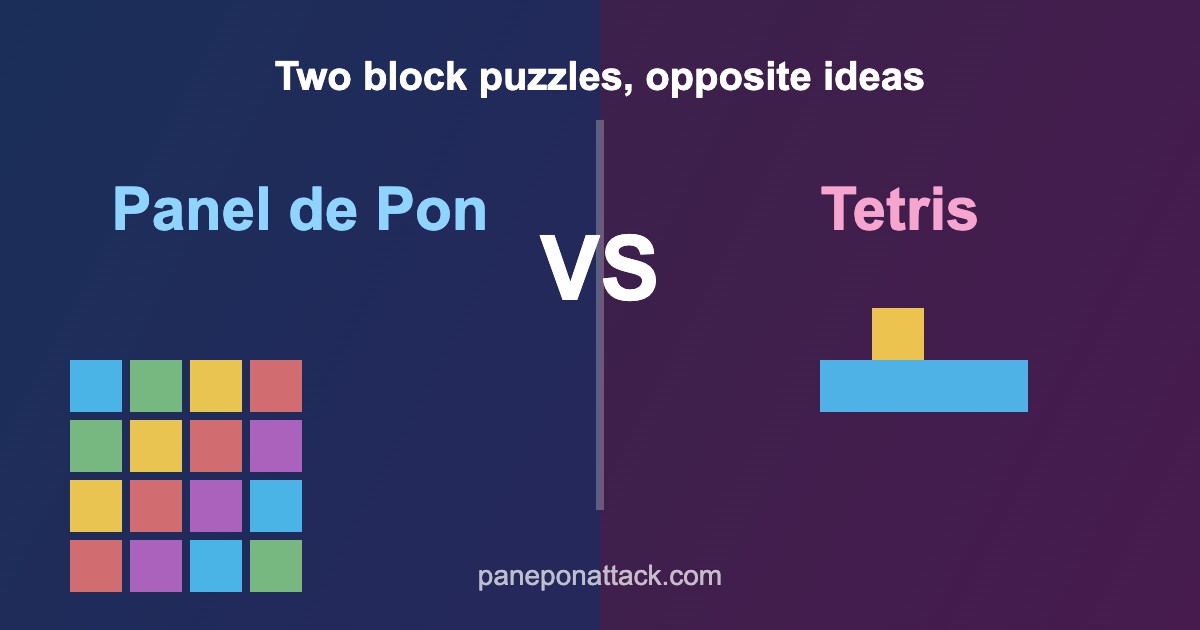
If you found this site by searching “Tetris Attack” and ended up reading about Panel de Pon, you already know why people confuse these two games. Nintendo literally reskinned Panel de Pon into Tetris Attack for the West and borrowed the most famous name in puzzle history to sell it. But here is the thing almost every casual player gets wrong: Panel de Pon and Tetris are not variations on the same idea. They are opposite puzzle philosophies that happen to share a marketing surname.
This guide is for the player deciding which one to sink hours into, or trying to understand why skill in one does not transfer to the other. I will be honest about who each game is not for, because that is usually the more useful half of the answer.
The one-line difference: gravity works against you in opposite directions
In Tetris, pieces fall toward you from the top and you decide where they land. In Panel de Pon, the whole stack rises away from the floor toward the top, and you rearrange what is already there before it reaches the ceiling. That single reversal changes everything downstream: how you plan, what “a good move” means, and whether you are reacting to the game or forcing the game to react to you.
Panel de Pon vs Tetris at a glance
| Dimension | Panel de Pon | Tetris |
|---|---|---|
| Core action | Swap two adjacent panels horizontally | Rotate and drop a falling tetromino |
| Stack direction | Rises from the bottom | Falls from the top |
| How you clear | Line up 3+ same-color panels in a row or column | Fill a complete horizontal line |
| Skill ceiling move | Chains (cascading clears you set up in advance) | T-spins and back-to-back tetrises |
| Failure state | Panels reach the top of the well | Stack reaches the top of the well |
| Piece you receive | You never receive pieces; you edit the board | A queue of pieces you must place |
| Mindset | Proactive setup and timing | Reactive placement and cleanup |
| What punishes you | Hesitation while the stack creeps up | A single misplaced piece creating a hole |
How Tetris actually works
Tetris hands you a randomized queue of seven tetromino shapes. Your job is spatial: rotate each piece and slot it so that horizontal lines fill completely and vanish. You do not choose your pieces, so the game is a negotiation between the board you have and the piece the bag gives you next. Mastery is about keeping your surface flat, leaving a clean well for the vertical I-piece, and stacking so a bad sequence never forces a hole.
The pressure in Tetris is external. The pieces keep coming whether you are ready or not, and speed ramps until your placement can no longer keep up. It rewards clean, fast, low-risk decisions repeated hundreds of times without a slip.
How Panel de Pon actually works
Panel de Pon gives you a grid of colored panels and a two-tile cursor. Your only move is to swap two side-by-side panels. Match three or more of the same color, horizontally or vertically, and they clear. Meanwhile the entire field rises one row at a time from the bottom, and if any column touches the ceiling, you lose.
What makes the game deep is that clearing panels causes the ones above to fall and settle, which can trigger another clear you arranged ahead of time. That is a chain, and it is the whole game at a high level. If you are new to that idea, our breakdown of combos versus chains in Panel de Pon explains why the two are not the same thing. You are not placing pieces; you are gardening a board you already own.
Reactive vs proactive: the mental model that separates them
Tetris rewards clean reaction
A strong Tetris player reacts beautifully. They read the incoming piece, find the least-damaging home for it, and keep the surface tidy so options stay open. The skill is execution under an accelerating clock. You are responding to what the randomizer feeds you.
Panel de Pon rewards planned aggression
A strong Panel de Pon player builds a trap. They deliberately leave colors “wrong” so that one clear collapses the board into a four- or five-step chain. The skill is foresight plus the nerve to hold a messy-looking board while the stack rises. You are not answering the game; you are setting the game up to answer you. This is also why the two games train completely different instincts, much like the split we cover in active versus passive chaining.
Difficulty curve: easy to start, hard where it counts
Tetris is famously easy to pick up. Anyone understands “fill the line.” The difficulty is a smooth, relentless ramp toward speeds where your hands become the bottleneck. Panel de Pon is the opposite shape of curve: the basic match-three swap is trivial, but the leap from “I clear panels” to “I build chains on purpose” is a real wall. Many players bounce off Panel de Pon not because it is fast, but because the thing that makes it great — deliberate chain construction — is invisible until someone explains it.
If you want the honest recommendation: Tetris gives you a satisfying first hour faster. Panel de Pon gives you a deeper hundredth hour.
Multiplayer and “attacks” compared
Both games shine in head-to-head play, but they attack differently. In competitive Tetris, clearing multiple lines sends garbage rows to your opponent from the bottom, pushing their stack up. In Panel de Pon, chains and combos drop garbage blocks onto the rival’s field that must be cleared before they break apart. The rhythms feel different: Tetris duels are about sustained downstacking pressure, while Panel de Pon duels swing on a single well-timed chain that buries the other player. If versus play is your goal, Panel de Pon’s attack economy is genuinely distinct — and it is worth learning why the same “Tetris” branding produced two different competitive games, which is exactly what our Tetris Attack (SNES) guide digs into.
So which one should you actually play?
Play Tetris if you want an instantly readable game, you enjoy execution under speed, and you like a clear, honest ramp where getting better means getting faster and cleaner. It is the better pick for short sessions and for anyone who finds “figure out the trick” frustrating.
Play Panel de Pon if you want a puzzle you can scheme against, you enjoy building something and detonating it, and you are willing to sit through an awkward learning wall for a much higher strategic ceiling. It is the better pick if you found Tetris “solved” for you and want a game that rewards planning over reflexes.
They are not competitors so much as two answers to the question “what should a block puzzle feel like.” One says react perfectly. The other says plan ruthlessly. Knowing which sentence describes you is the whole decision.
Frequently asked questions
Is Tetris Attack the same as Tetris?
No. Tetris Attack is a renamed version of Panel de Pon and shares no mechanics with Tetris — it uses swapping and rising stacks, not falling tetrominoes. Nintendo attached the Tetris name for Western marketing only.
Is Panel de Pon harder than Tetris?
They are hard in different ways. Tetris gets harder through raw speed; Panel de Pon gets harder through the strategic depth of building chains. Panel de Pon has a steeper early learning wall, while Tetris has a steeper late execution demand.
Does skill in Tetris transfer to Panel de Pon?
Barely. General puzzle composure and pattern recognition carry over, but the core skills — falling-piece placement versus rising-stack chain setup — are almost opposite, so most players start close to scratch in the other game.
Which one is better for competitive multiplayer?
Both are excellent. Choose Tetris for fast, execution-heavy duels and Panel de Pon if you prefer matches decided by planned chains and garbage-block timing.
\n