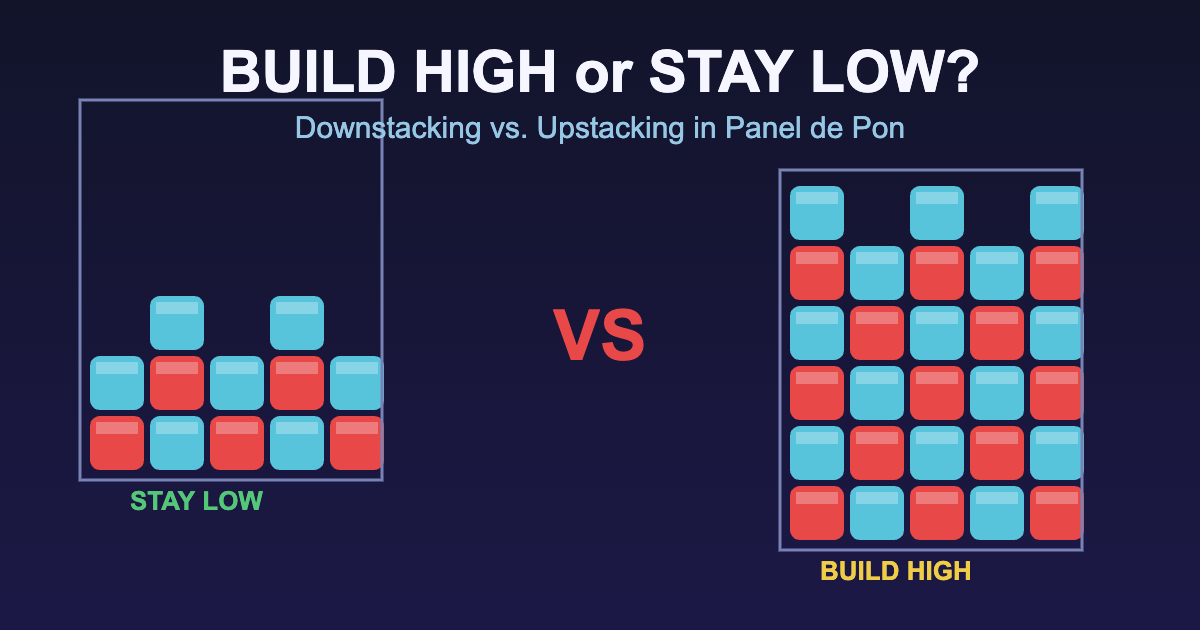
Ask two strong Panel de Pon players how to survive a fast Endless run and you will often get opposite answers. One says the same thing every time: keep the board low, clear anything you can, never let the stack breathe near the top. The other shrugs and lets the panels pile halfway up the screen, calm as anything, waiting to unload a chain that wipes half the board in one motion. Both players are good. They are just running two different operating systems — and most people never realize there is a choice being made at all.
That choice is the tension between downstacking and upstacking: whether you spend your swaps buying safety or buying potential. Understanding it is the difference between playing Panel de Pon reactively and playing it on purpose. Here is what each philosophy actually does to your board, and—more importantly—how to know which one you should be running right now.
What “downstacking” and “upstacking” really mean here
The terms come from stacker-puzzle culture, but Panel de Pon bends them into something specific. You never place a piece in this game. The stack rises on its own (or when you tap raise), and all you ever do is swap two adjacent panels sideways. So downstacking and upstacking are not about how you move—the mechanics are identical either way—they are about the intent behind every swap.
When you are downstacking, every clear is aimed at one thing: lowering the board and resetting the clock in your head. You take the three-match the instant you see it. You value a low, quiet stack over a big score. When you are upstacking, you do the opposite. You deliberately leave panels unspent, let a little height accumulate, and use that height as raw material to build a longer chain before you fire it. One approach treats height as a threat to be neutralized. The other treats height as fuel.
The case for staying low
A low board is a legible board
The single biggest reason to downstack is information. When your stack is short, you can see the whole thing at a glance: which colors are clustered, where a chain wants to happen, what falls where after a clear. As the stack climbs, that legibility collapses. Rows compress toward the top, the danger warning starts flashing, the auto-raise often speeds up, and your decision window shrinks to almost nothing. A low board keeps you in the part of the game where you can actually think.
Safety is really tempo in disguise
Downstackers are not just playing scared. A board with lots of empty space at the top is a board you can raise into on your own terms. That is a genuine offensive resource: you get to choose when the next row arrives instead of being forced to react to it. Staying low is what lets you control the pace of the match rather than letting the game’s timer control you. If you want to go deeper on using the raise button as a tempo lever rather than a panic button, that idea gets its own full treatment in our guide to stack speed and manual raise as tempo control.
The case for building high
Height is stored potential
Every panel you clear the moment you see it is a panel you can never use in a bigger combination later. Upstackers understand that a chain is worth far more than the sum of its parts—a four-link chain does not send four times the pressure of a single clear, it sends dramatically more, and it does it all at once. To build that four-link chain you need panels to work with, and panels are exactly what you throw away when you reflexively downstack. Letting the board rise a little is how you keep enough material on hand to assemble something devastating.
The taller board is a wider canvas
Big chains in Panel de Pon are built vertically: you clear a group low, panels above collapse into a new match, that clears, more panels fall, and the reaction cascades upward. A tall stack simply gives you more floors for that cascade to travel through. Skilled upstackers will intentionally carry height into the mid-game specifically so they have room to stage a “skyscraper” chain that a low, tidy board could never physically produce. In versus play, one well-loaded upstack can bury an opponent under garbage before they have set up anything at all.
Why the best players do both—and switch on purpose
Here is the part most guides miss. Downstacking and upstacking are not personality types you pick once. They are gears, and the whole skill is knowing when to shift. Lock yourself permanently into either one and you have a predictable, exploitable weakness: the pure downstacker never threatens anyone, and the pure upstacker eventually tops out chasing a chain that was never going to come together.
Read the board, not your pulse
The trigger for shifting gears should be the state of the board, not the spike of adrenaline you feel when the stack gets tall. Panic makes people mash the nearest clear—an involuntary, sloppy downstack that wastes good setups. Deliberate players instead learn to look at a rising stack and ask whether it is dangerous or merely tall-but-organized. Training that read is its own discipline, and we broke it down in detail in reading the board: stack management and the danger state.
Manual raise is an upstacking tool
Once you are comfortable, the raise button stops being something that happens to you and becomes something you do. Tapping raise to bring up a fresh row is often the fastest way to complete a chain setup—a controlled, voluntary upstack. The catch is that you can only afford to do it when you have low-board safety banked, which is exactly why the two philosophies feed each other instead of competing.
Endless and Versus change the math
Context decides the default. In a solo speed mode, survival compounds—every extra second alive raises the speed and the score, so a conservative downstacking baseline with occasional opportunistic chains tends to last longest. Our Endless mode survival roadmap leans heavily on that logic. In versus, the incentive flips: you often have to upstack and threaten, because a passive low board just lets a patient opponent set up the chain that ends you first.
A field guide to switching gears
When you are unsure which mode you should be in, run down a short mental checklist. Downstack when the board is climbing past comfortable and getting hard to read, when the auto-raise speed has ticked up, when you have no chain materializing and are just holding scattered colors, or when you are ahead in a match and only need to not lose. Upstack when the board is low and calm, when you can see a chain waiting to be built if you hold your clears for a beat, when you have safe empty space above to catch falling panels, or when you are behind and need a big swing to get back into it. Above all, treat the shift as a decision you make, not a mood you fall into.
Three mistakes this framing fixes
First, the marathon downstacker who wonders why they never improve: clearing every match on sight builds fast hands but never teaches chain construction, so they hit a ceiling and stay there. Second, the greedy upstacker who tops out over and over: building height with no safety margin means one misread and the board is at the ceiling with the chain still half-assembled. Third—the most common of all—the player who does neither on purpose and simply reacts, downstacking out of fear and upstacking out of laziness, never choosing either. Naming the two modes is what turns that fog into an actual decision you can practice and win.
Frequently asked questions
Is downstacking or upstacking better in Panel de Pon?
Neither is better on its own—they are situational. Downstacking keeps you safe and legible and is the sensible default in solo speed modes; upstacking stores potential for big chains and is often mandatory in versus. Strong play means switching between them based on board state, not committing to one.
Does Panel de Pon actually have downstacking like Tetris?
Not mechanically—you never place pieces, and the stack rises automatically. But the strategic tension is real: every swap either aims to reduce height and buy time (downstacking) or to preserve panels for a larger chain (upstacking). The words describe your intent, not a distinct game action.
How do I stop panic-clearing when my stack gets tall?
Build the habit of pausing to read whether a tall stack is genuinely dangerous or just tall-but-organized before you touch anything. Banking low-board safety earlier in the game gives you the breathing room to make that read instead of mashing the nearest match.
When should I deliberately let my board get high?
Let it rise when the board is calm, you have empty space above to catch falling panels, and you can see a chain worth building if you hold your clears for a moment—or when you are behind and need a large swing. Avoid it when the auto-raise has sped up or the board has become hard to read.