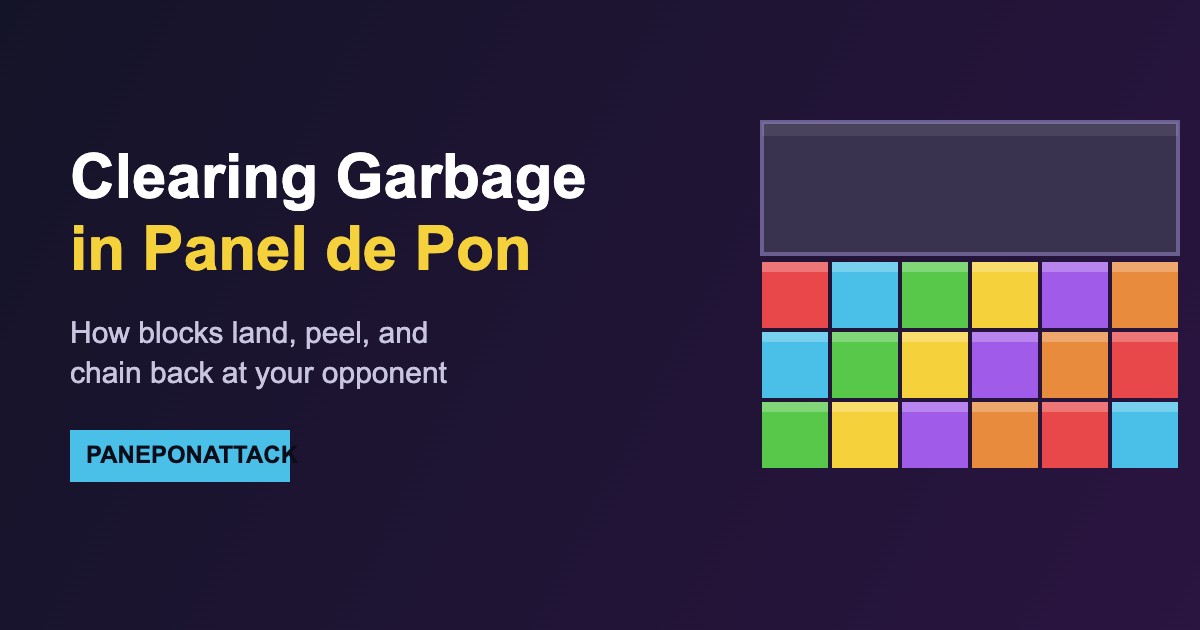
Every guide to Panel de Pon teaches you how to send garbage. Almost none of them teach you what happens when it arrives. Yet the moment a gray slab drops onto your stack is the single highest-leverage moment in a versus match: play it wrong and you eat a burial; play it right and you convert your opponent’s attack into a bigger one of your own. Garbage is not a punishment. It is fuel that has been delivered to your doorstep, still wrapped.
This is a mechanics-first look at the block nobody chooses to receive. We will walk through what a garbage block physically is, how it “peels” back into playable panels, why chaining through garbage is the core of high-level defense, and how to read incoming pressure before it lands. If you have ever felt buried the instant garbage hit, the problem was almost never the garbage. It was that you did not know what it was about to do.
What a Garbage Block Actually Is
A garbage block is a solid gray rectangle that occupies whole grid cells but cannot be swapped, moved, or matched directly. In Panel de Pon and its Western releases (Tetris Attack, Pokémon Puzzle League) it comes in two shapes. Line garbage is one row tall and spans some number of columns — up to the full six. Block garbage is at least two rows tall, a chunky slab. The width and height encode how much damage your opponent committed: a fat combo sends a wide line, while a long chain stacks tall blocks.
The critical property is that garbage sits on top of your stack and rides it upward exactly like your normal panels. It does not phase through anything. It does not stick to the ceiling. It obeys gravity and the same rising conveyor your board already runs on. That means garbage is subject to every tool you already own — you just cannot touch it until you convert it.
Why the shape matters
Shape is information. A single full-width line tells you the opponent landed a mid-size combo and wants to pin your cursor across the whole board. A tall two- or three-high slab tells you they built a real chain and are betting you cannot clear it before your stack tops out. Reading shape at a glance lets you decide whether to clear immediately or to keep building your own counter first.
The Peel: How Garbage Turns Back Into Panels
You clear a garbage block by making a normal match adjacent to it. Line up three or more panels touching the garbage, execute the clear, and the block “peels”: the row of the garbage in contact with your clear flashes, then transforms into ordinary colored panels that fall into your stack. Those new panels are yours to use immediately.
Two details separate players who survive from players who drown. First, the transform is not instant. There is a flash animation while the garbage resolves into panels, and during that window the newly created panels are locked. Second, and this is the part most guides skip, a clear only peels the layer of garbage it directly touches. A three-high slab does not vaporize because you cleared next to its bottom row. The bottom row converts; the two rows above it remain garbage and settle down onto the panels you just created. You have to clear again to eat the next layer.
The clear travels top-down through a slab
When your match touches a tall block, the conversion propagates one row at a time from the contact edge. Practically, this means peeling a big slab is a multi-step operation, and each newly revealed layer arrives already colored — which is precisely what makes garbage so powerful for the defender. You did not choose those colors, but they drop into your board pre-sorted by the game, often lining up matches you never set up yourself.
Chaining Through Garbage: Defense That Attacks
Here is the whole game in one sentence: if the panels a garbage block releases immediately complete another match, that match counts as the next link in a chain. This is the mechanic that turns eating garbage into a counterattack. You clear next to the slab, the bottom layer peels into fresh panels, those panels fall, and if they land into a waiting three-match, the chain continues — and every additional link both clears more of the slab and sends larger garbage back.
Skilled defenders set this up on purpose. Before clearing into a slab, they arrange a “landing zone” underneath: a partially built column primed so that whatever peels out has a strong chance of completing a match on contact. Because the released panels are colored by the game, you are partly gambling, but the gamble is heavily loaded in your favor when you leave open, flat rows for the peel to drop into. This is the same tempo discipline covered in our breakdown of the chain window and how long you really have to extend a chain — the garbage peel simply hands you a free extra link if your timing holds.
The counterattack math
A defender who converts a full-width line into a two- or three-link chain does not merely survive; they typically send back more garbage than they received. That is why a match can swing on a single well-eaten slab. The attacker spent tempo building their combo; the defender spends one clean clear turning it around and now holds the initiative. Managing that swing is the heart of the offense–defense balance in versus mode.
Reading Incoming Garbage Before It Lands
In most versions, garbage does not teleport onto your stack the instant your opponent scores. It queues and drops from the top of the playfield, and there is a brief telegraph. Watching the top of your own board — not just your opponent’s — is a trainable habit. When you see a slab about to enter, you get a fraction of a second to reposition your cursor and prep the landing zone below where it will fall.
Panicking is the default failure. The stack looks suddenly taller and the danger alarm may trigger, so new players mash swaps at random and destroy their own setups. The fix is to treat the incoming slab as a scheduled event, not a surprise. You already know it is one row or two, full width or partial, and you already know roughly where it will settle. That is enough to plan one clean clear instead of five frantic ones. If it does push you into the red, the recovery principles in our guide to reading the board and surviving the danger state apply directly.
Practice Drills for Garbage Confidence
Garbage handling is a skill you can isolate and rep. Three drills build it fast:
1. The single-line peel. In a versus session against the CPU, deliberately take a small line of garbage and practice clearing it in exactly one match, then immediately reassessing. The goal is not speed — it is making the peel a calm, deliberate action instead of a reflex.
2. The slab ladder. Let a two- or three-high block land and practice peeling it layer by layer, one clear per row, without letting the residual garbage push you into danger. This teaches you the top-down conversion rhythm and stops you from expecting a slab to vanish all at once.
3. The counter setup. Before you clear into any garbage, force yourself to build a two-panel landing zone underneath first. Even if the peel colors do not cooperate, the habit of prepping the landing is what eventually produces free chain links. Deliberate reps like these are the whole idea behind an efficient short practice routine rather than mindless marathon play.
Do these against a slow-rising CPU where the stakes are low, then carry the calm into real matches. The player who does not flinch when garbage lands is, functionally, playing a different game than the one who does.
Frequently Asked Questions
How do you clear a garbage block in Panel de Pon?
Make a normal match of three or more panels directly adjacent to the garbage. The layer of garbage touching your clear peels and transforms into ordinary colored panels, which then fall into your stack and become usable.
Why doesn’t my whole garbage slab disappear when I clear next to it?
A clear only converts the single layer of garbage it directly touches. A tall block peels one row at a time from the contact edge, so a three-high slab needs multiple clears — each newly revealed layer settles down and must be cleared again.
Can eating garbage actually help you win?
Yes. If the panels released by a peeling garbage block immediately complete another match, that match extends a chain. A well-set-up defender can turn incoming garbage into a multi-link chain and send back more garbage than they received.
What’s the difference between line garbage and block garbage?
Line garbage is a single row spanning some or all of the six columns and is usually sent by combos. Block garbage is two or more rows tall — a solid slab — and is usually sent by chains. The shape tells you how the opponent scored and how many clears you will need to peel it.
How do I stop panicking when garbage lands?
Treat the incoming slab as a scheduled event, not a surprise. Watch the top of your own board for the telegraph, note the slab’s size and landing column, and plan a single clean clear with a prepared landing zone below it rather than mashing random swaps.