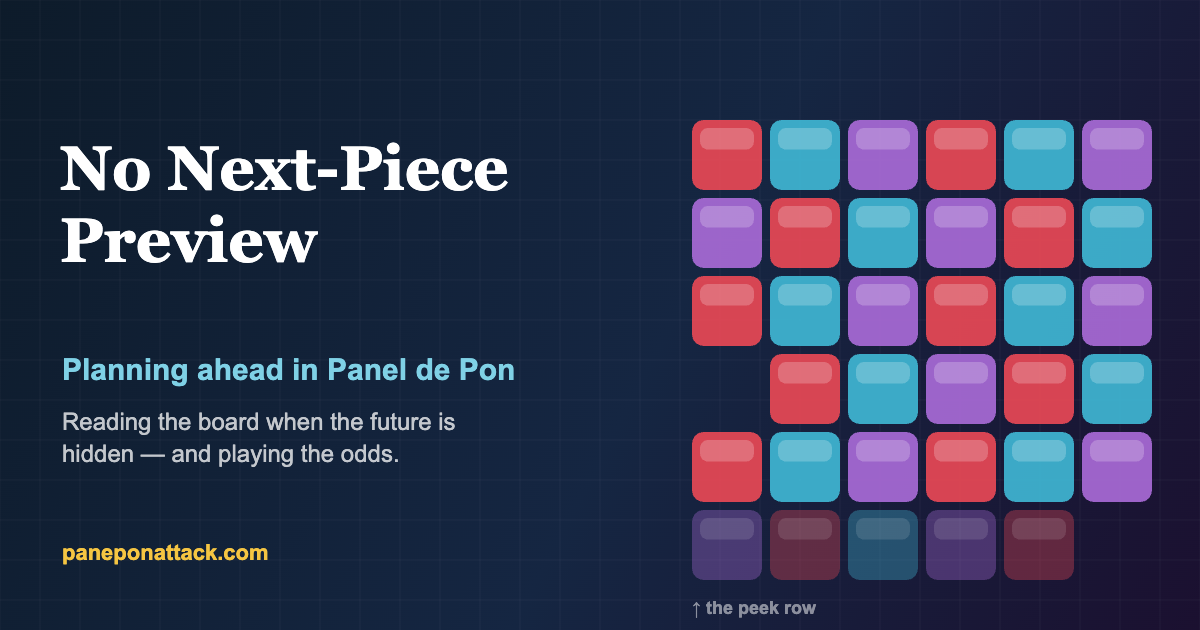
Come to Panel de Pon from almost any other puzzle game and one absence hits you immediately: there is no next-piece preview. Tetris hands you a queue of five or six upcoming pieces. Puyo Puyo shows you the next two pairs in the sidebar. Panel de Pon shows you nothing but a thin, dimmed sliver of panels creeping up from the bottom edge. And yet the best players in the world plan several moves ahead, build multi-stage chains before the panels to complete them even exist, and almost never get caught flat-footed. How?
The short answer is that Panel de Pon replaces knowing the future with shaping the present so any future works. That is a different discipline, and once you understand it, the game stops feeling like reaction-time roulette and starts feeling like a game of managed risk.
What you actually get instead of a preview
Panel de Pon does give you exactly one piece of forward information, and most newcomers ignore it: the peek row. At the very bottom of the playfield, a partially-risen row of panels sits dimmed and inactive. You cannot swap it, cannot chain with it, cannot clear it. But you can see its colors. That dim row is the next set of panels that will become live the moment the stack rises one increment.
This is not a five-piece queue. It is a one-row lookahead, and it is grainy — you know the colors that are coming, but not how you will be forced to arrange them. Still, reading the peek row is the single biggest planning skill in the game. It tells you, a beat early, whether the red you have been saving is about to get reinforcements, or whether you are about to be flooded with a color you cannot yet use.
Why the row is random — but not fully random
New rows are generated so that they never enter the board already matched. The game will not hand you three-in-a-row of the same color on entry, because that would auto-clear and break the fairness of the mode. That single constraint is why the incoming panels always look slightly scrambled, and it is why you can lean on a soft probability: no color will ever arrive as a pre-made match, so every clear on the bottom rows is something you have to build. Understanding what each panel is doing frame by frame — which ones are settled, which are still falling, which are locked mid-clear — is the foundation for reading that incoming row correctly. If that layer is fuzzy for you, our breakdown of panel states frame by frame is worth a detour before you go further here.
Planning without a queue: build skeletons, not sequences
In Tetris, planning is deterministic. You can see an I-piece three slots away and pre-dig the well to receive it. Panel de Pon punishes that mindset. If you commit to a plan that depends on a specific color showing up, the RNG will eventually strand you.
Strong players plan the opposite way. Instead of a sequence (this color, then that color, then clear), they build a skeleton: a chain structure with a deliberately empty slot that any color can complete. The classic version is a partially stacked chain where the trigger panel is missing, and you simply feed whichever color arrives into the gap. You are not predicting the future; you are pre-committing to a shape and letting the future slot itself in.
Optionality is the currency
The mental model that unlocks this is optionality. Every panel you place either increases or decreases the number of good moves you will have next turn. A tidy board with two or three half-built clears in different colors gives you options no matter what rises. A messy board where everything depends on one specific match gives you a single point of failure.
This is why board organization matters more here than in games with a preview. You are not reacting to a known feed; you are keeping the board in a state where the unknown feed cannot hurt you. The strategic tension between stacking high for big chains and staying low for safety is really a tension about how much optionality you are willing to trade for payoff — a decision we unpack in detail in the downstacking vs. upstacking decision.
Controlling when the future arrives
Here is the twist that even intermediate players miss: you cannot choose what comes next, but you have real control over when it comes. The manual raise button pulls the peek row up into play on demand. That means the arrival of new panels is not a metronome you are helpless against — it is a lever.
Once you have read the peek row and you like what you see, raising immediately turns a preview into usable material. If the incoming colors are ugly, you hold, clear what you can, and reshape the board before letting them in. Planning in Panel de Pon is therefore less about forecasting and more about timing your own exposure to randomness. You decide the moment the dice get rolled.
The cursor is already there when the row lands
Reading the peek row also lets you pre-position. Because you know the colors a beat early, you can move the cursor toward where those panels will land before they go live, so that the instant they become swappable you are already executing rather than searching. This is invisible to a spectator, but it is a big chunk of what separates a fast player from a merely accurate one.
How this differs from coming-from-Tetris instincts
If your muscle memory is trained on queue-based games, the hardest habit to unlearn is waiting for the right piece. In Tetris that is often correct — you can stall for the I-piece you can see coming. In Panel de Pon there is nothing to wait for, so waiting is just letting your stack climb toward the top for free. The winning instinct is to keep acting, keep the board flexible, and treat the peek row as a nudge rather than a promise. Players making exactly this transition will recognize the friction we describe in what transfers from Tetris and what betrays you.
A practice routine for planning under uncertainty
You can train this directly rather than hoping it develops. Try these three drills, five minutes each:
1. Narrate the peek row. Play Endless and say the incoming colors out loud before every raise. It feels silly, but it forces your eyes to actually check the dim row instead of tunnel-visioning the active board.
2. Build one blind skeleton per board. Deliberately construct a chain with a missing trigger and refuse to complete it until the color you need happens to arrive naturally. This teaches you to hold a plan open rather than forcing it.
3. Raise on your terms. Spend a session where you only ever add rows with the manual raise, never passively. You will feel how much agency you actually have over the pace, and how often passive play was quietly burying you.
Do these for a week and the absence of a preview stops feeling like a handicap. It starts feeling like what it is: a design choice that rewards adaptability over memorization, and reading over predicting.
Frequently asked questions
Does Panel de Pon have a next-piece preview at all?
Not in the Tetris sense. There is no queue of upcoming rows. The only forward information is the dimmed peek row at the bottom of the playfield, which shows the colors of the single next row before it becomes active.
Are the incoming rows completely random?
They are randomized, but with one key rule: a new row never enters the board already forming a match of three or more. That constraint is why every clear on the bottom rows has to be built by the player rather than handed to you.
Can you influence what colors come next?
You cannot choose the colors, but you control the timing with the manual raise button. Reading the peek row and deciding when to pull it into play is the closest thing the game has to managing the queue.
How do top players plan ahead without a preview?
They build flexible chain skeletons with an open slot that any color can complete, keep the board organized to preserve options, and use the peek row plus manual raise to time their exposure to randomness rather than predicting it.
Is planning in Panel de Pon harder than in Tetris?
It is a different skill rather than a harder one. Tetris rewards deterministic planning around a known queue; Panel de Pon rewards probabilistic planning and fast adaptation. Players who over-rely on waiting for a specific piece tend to struggle at first.